
Last time we talked about some of my subjective experiences with Amanita Muscaria. Today we get nerdy about it.
TL;DR: You probably do not want to be microdosing it for too long. Feels good thought…
In the last post we discussed some of the effects that the fly agaric has on users. I feel like I might have hyped some you a bit too much regarding its effects when microdosing, but I wanted to be completely honest about how I felt on it. Yes, it feels good. I feel more productive, I feel less depressed, but I feel a lot of other things that I believe are not talked about enough in posts about this.
Before we start I must say: I swear I’m trying my best to keep it as simple as possible. That doesn’t mean, however, that I am willing to treat you like kids, so get ready to fight some concepts for a while. It’s going to be worth it, that much I can guarantee. So yeah, here is a list of our sections:
Muscimol
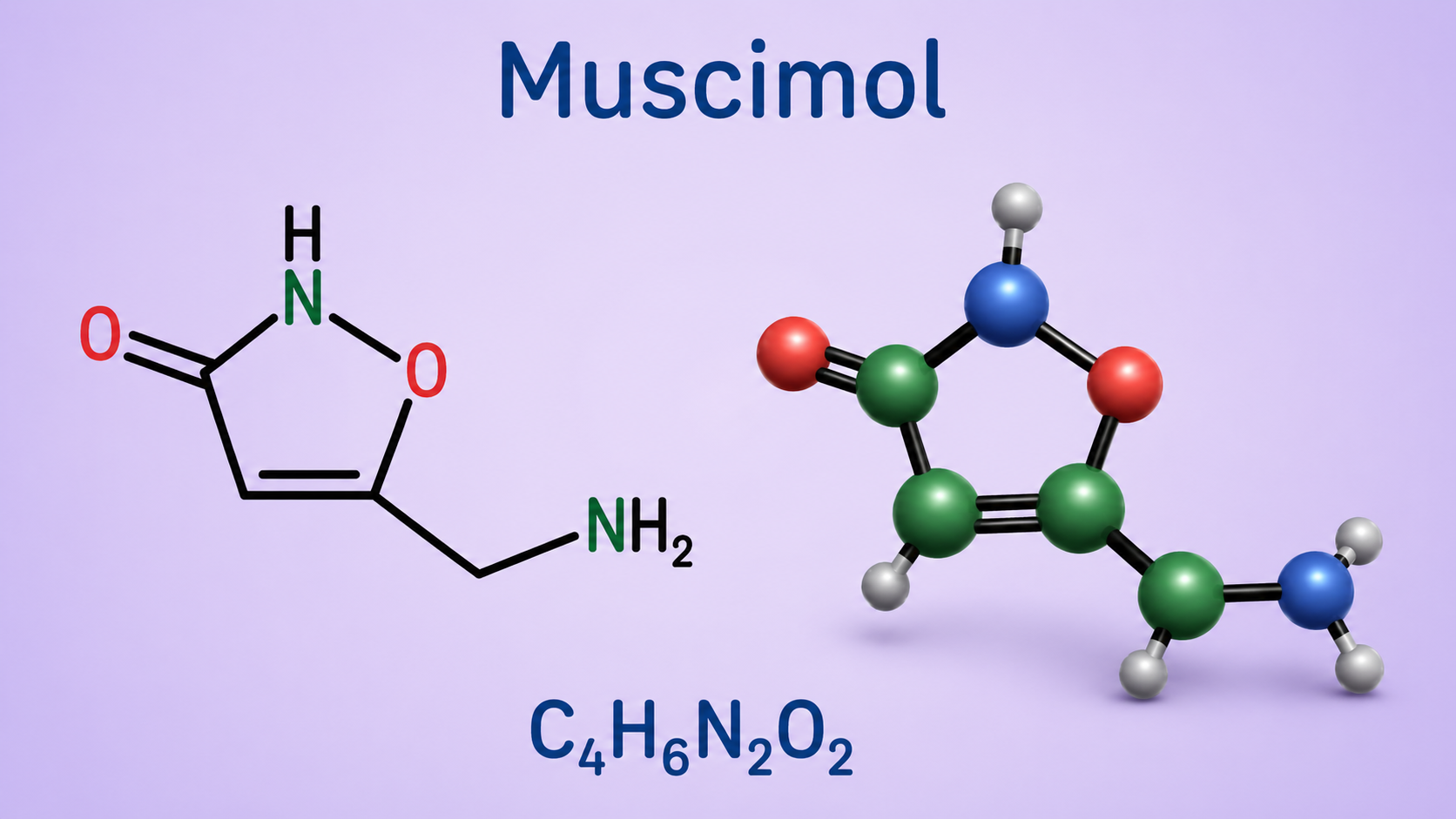
Muscimol is a small and relatively simple aromatic alkaloid and a structural mimic of GABA. It closely resembles the brain’s main inhibitory neurotransmitter well enough that most of our biochemical processes cannot properly distinguish between them.
Because of that similarity, and of its chemical properties (muscimol resembles GABA in the spatial placement of key polar/charged interaction points), muscimol is also an orthosteric agonist of GABA. It is most likely to bind the same primary binding sites as natural GABA in GABA-A receptors. Most orthosteric ligands bind the same main sites as the natural ligands in general but we wouldn’t be having this long conversation if muscimol was boring like that, would we?
In your brain there is only one gamma-aminobutyric acid and it will bind in a predictable way to its different receptors. Muscimol is not GABA. Because it only mimics GABA, different receptors have different reactions to it. Muscimol binds and especially unbinds much more slowly to δ-subunit receptors, which gives prolonged receptor occupancy, mainly by slowing muscimol kinetics, notably dissociation. 1
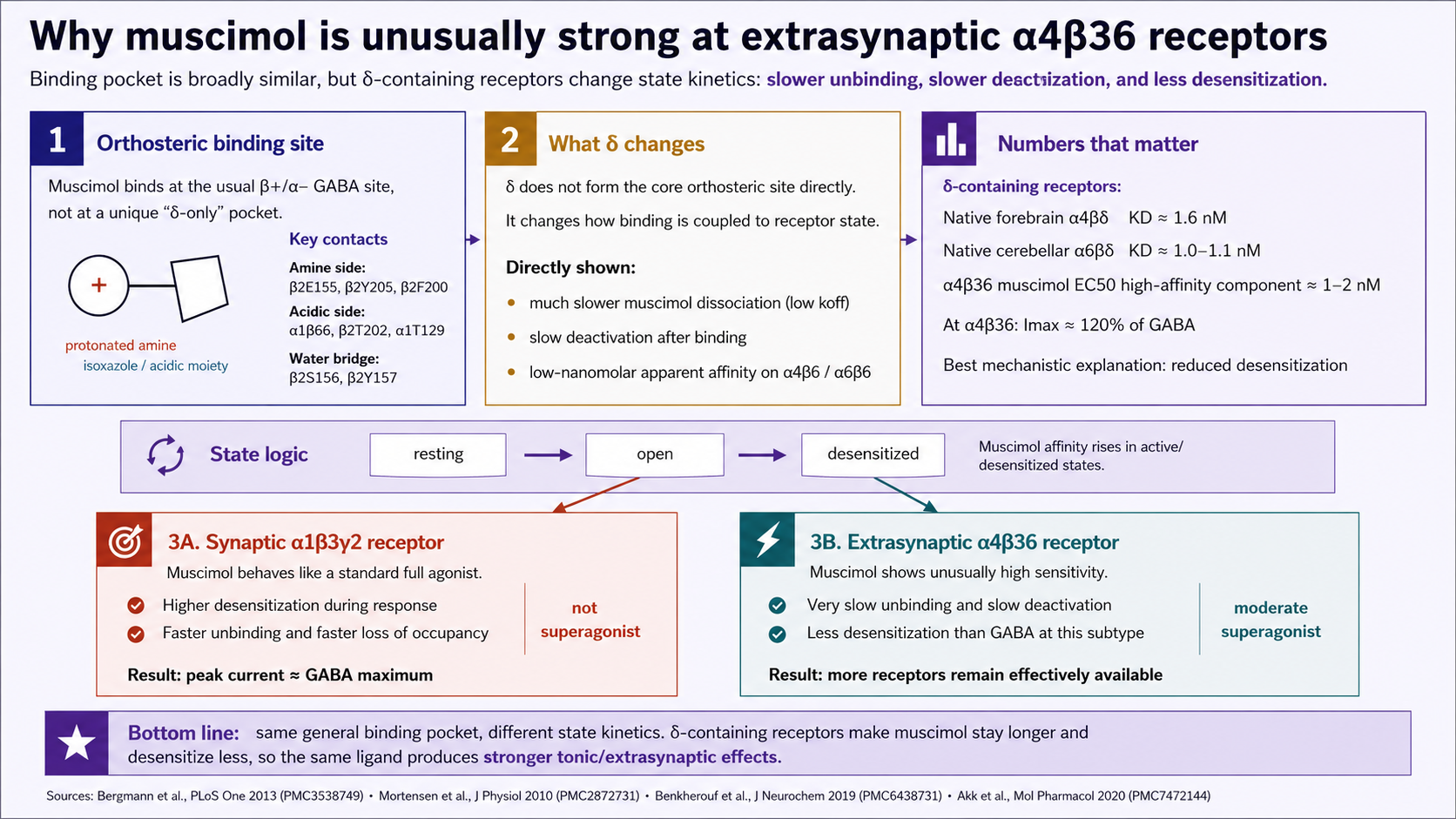
A GABAA receptor is a chloride channel that can occupy three main functional states during exposure:
- Resting: the receptor is not conducting ions and is still in the baseline closed conformation. For the neuron, resting-state receptors are simply unavailable at that moment for inhibition because no chloride current is flowing through them.
- Active: after an agonist binds to the receptor it shifts into the conducting (or active) state, so the pore is open and chloride can pass. For the neuron this is the functionally inhibitory phase, making it harder to excite.
- Desensitized: “bound but silent”. The receptor is still agonist-bound, but became non-conducting again. 2 3
Muscimol binds GABAA receptors with different affinities depending on whether they are in resting, active, or desensitized states, and high-affinity binding is favored when receptors are in active or desensitized conformations rather than the resting state. When muscimol remains present long enough, many receptors move from active into desensitized states, where it can still bind with high affinity but the channel no longer conducts (neurons do not get inhibited). 4
Beyond the immediate effects of sensitization/desensitization, those states also affect receptor organization on the neuron, not just instant current flow. When researchers biased receptors towards those two conformations, they found changes in receptor mobility, confinement, subsynaptic domain organization and the anatomical subsynaptic scaffolding (gephyrin scaffold structure), indicating that state occupancy can feed into longer-lived synaptic remodeling. 5
Woof! I mean, oof! We finally got where we wanted:
TL;DR: Because of how muscimol works on the GABAergic system, and how strongly it binds to certain GABA receptors, muscimol has two main phases of action: one in which it presents the traditional GABA agonist effects (it makes you eepy and more extroverted), and another in which prolonged exposure can shift receptors into states that alter how inhibitory synapses are organized afterwards. In other words, it directly affects synaptic plasticity: it changes your brain.
Brain Networks and Circuits
As we discussed before, muscimol has an outsized ability to alter tonic inhibition and background network state. What we haven’t said clearly yet is that this effect is especially stronger in circuits enriched for extrasynaptic receptor populations: the cerebellum, the thalamus, the hippocampus, the basal ganglia, the neocortex, the amygdala and other stress-related limbic circuits as well as the brainstem respiratory networks.
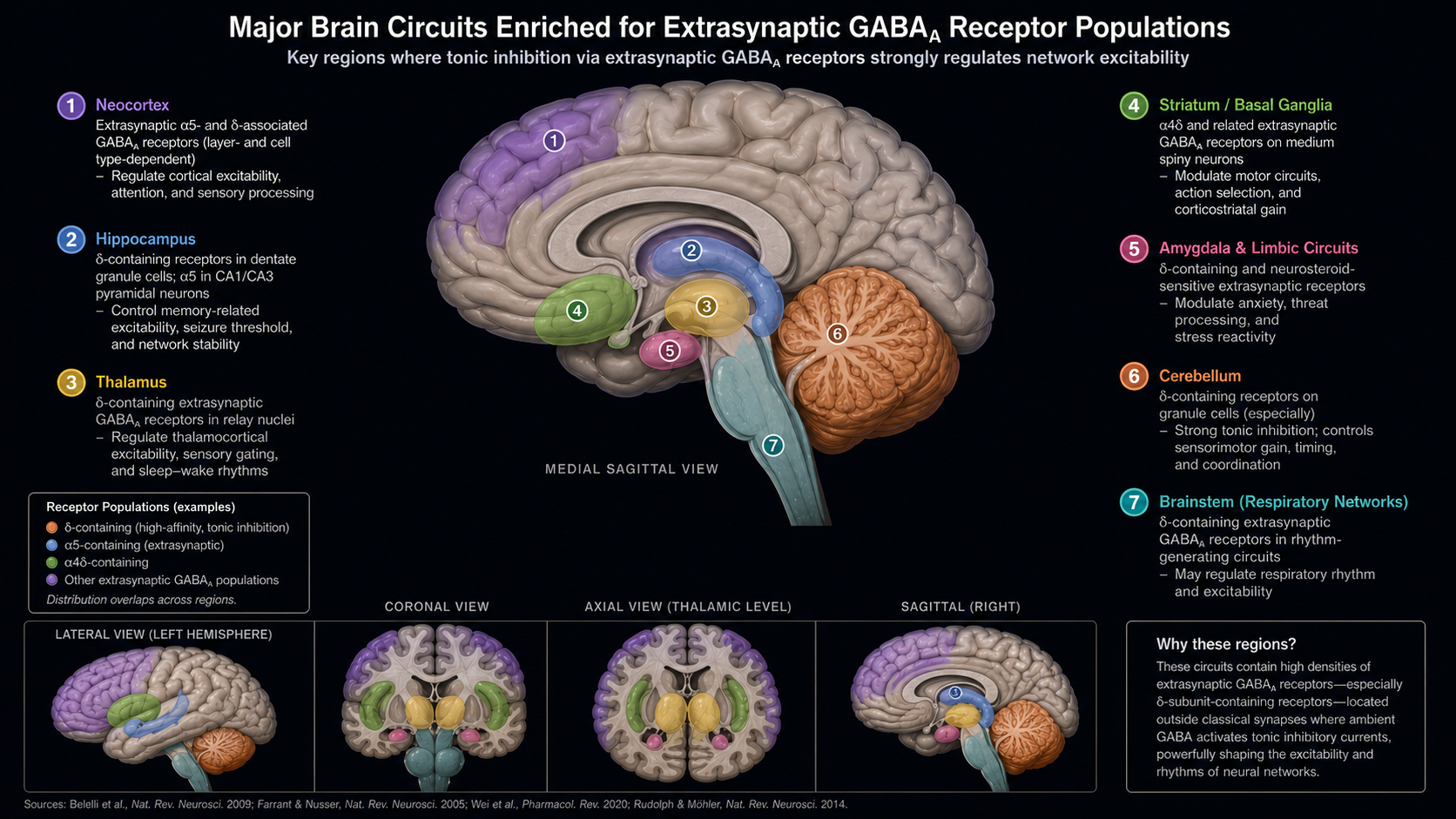
I believe this is important enough that I would like to reinforce it: muscimol does not make an entire brain region “immune to GABA”, it drives some receptors into high-affinity nonconducting desensitized states, so binding can stay high while tonic current falls. With prolonged exposure, that can be followed by receptor redistribution, clustering loss, endocytosis, and compensatory changes in surface expression of α4-, α5-, and δ-containing receptors, so circuit remodeling is a real possible outcome 6 which can lead to a series of long-term changes including circuit-specific behavioral alterations:
- On extrasynaptic thalamic systems, it can result in lighter and more fragmented sleep, easier waking, increased sensory sensitivity, poorer sensory filtering, more distractibility, unstable attention, greater background mental or sensory “noise,” more restlessness or rebound arousal, less stable slow-wave sleep, altered body-sensation or pain salience, and possible absence-like episodes such as brief staring spells, lapses in awareness, or momentary interruptions in speech or action. 7
- For neocortical extrasynaptic systems, it could produce stronger sensory intensity, weaker filtering of background input, easier overstimulation, more distractibility, unstable attention, more intrusive visual/tactile/body sensations, faster shifts between calm and alert states, poorer tolerance of busy environments, less stable sensory gating, increased restlessness or irritability.
- On neocortical interneuron extrasynaptic systems, chronic usage can potentially result in poorer sensory binding, less precise timing of perception, unstable attention, weaker executive control, more distractibility, difficulty keeping thoughts organized, reduced working-memory stability, more fragmented perception in busy environments, poorer filtering of irrelevant stimuli, faster shifts between overfocus and scattered attention, increased sensory overload. 8
- Reagarding hippocampal extrasynaptic systems, we are looking at possibly stronger memory encoding but less stable memory filtering, easier formation of some associations, more intrusive or noisy memories, poorer separation between similar experiences, increased rumination or mental replay, unstable emotional learning, more context confusion, sleep-related memory disruption. 9
- Cerebellar granule cells have the strongest canonical extrasynaptic enrichment in the brain. Here we are looking at greater anxiety-like behavior, poorer stress regulation, increased emotional reactivity, altered social behavior, reduced social stability, disrupted caregiving or attachment-related behavior, more repetitive or poorly regulated behavioral patterns, noisier sensorimotor timing, reduced tolerance for unexpected stimuli, and possible subtle coordination or timing problems even without obvious baseline motor impairment. 10 11
- On striatal extrasynaptic systems, chronic muscimol use could produce altered reward sensitivity, lower motivation, reduced pleasure from normally rewarding activities, stronger or weaker habit formation depending on circuit state, more compulsive or automatic behavior, poorer action selection, less flexible decision-making, difficulty shifting away from routines, unstable drive, altered impulse control, changes in reinforcement learning, blunted goal-directed behavior, and possible vulnerability to addiction-like or anhedonia-like patterns. 12
- About the hypothalamic/PVN extrasynaptic systems, one could have a higher baseline stress, stronger stress responses, poorer stress recovery, increased anxiety-like arousal, irritability, autonomic overactivation, higher sympathetic “fight-or-flight” tone, more palpitations or body tension, worse sleep under stress, greater startle/reactivity, less stable appetite or energy regulation, poorer emotional regulation, and possible HPA-axis disruption involving cortisol/corticosterone rhythms. 13
- And, finally, on the spinal dorsal-horn and substantia-gelatinosa extrasynaptic systems, chronic use could result in lower pain threshold, stronger pain from normally painful stimuli, pain from normally harmless touch, increased mechanical sensitivity, increased thermal sensitivity, more burning or aching sensations, greater body discomfort, easier pain flare-ups after minor irritation, poorer filtering of nociceptive input, and higher risk of chronic pain-like hypersensitivity.
You might be saying to yourself: “okay then, chronic muscimol usage is just shitty ass bad.”. That’s not a bad conclusion at all but it’s also not the full picture. If muscimol weakens some of those background systems in the brain, some things can feel better for a while specially with short, controlled use: you may feel less foggy, less emotionally stuck, more awake, more creative, more sensitive to small details and more able to connect ideas and memories that usually feel far apart.
New memories and new behaviors can also become easier to shape, which is probably part of why it can feel useful for introspection, habit change, and creative work. The problem is that this comes from turning down some of the same filters that keep your brain stable. So, all things considered the “good” side isn’t free at all: the same process that can make you feel more open, more perceptive and more mentally flexible can also make you more sensitive, more scatterbrained, less grounded, more reactive and more vulnerable to weird long-lasting changes if you keep pushing it for too long.
How long you may be asking? ¯\_(ツ)_/¯
Important notes
As we talked initially, there is very limited evidence for chronic muscimol usage. That means most of those “muscimol can cause” lines are mostly inference from different evidences of how those systems work and how they react to the kind of compensatory weakening of tonic inhibition we expect chronic muscimol usage to cause.
In my personal experience, after around two weeks of microdosing, those assumptions are fairly correct. One could say that the Fly Agaric worked as a kind of autism augmenter: I felt more absent, less verbal, absolutely could not stand noisy / chaotic environments, felt quite detached from reality and cared less about pretty much everything. I personally did not feel any negative effects regarding irritability, to the contrary, I felt super disconnected from the world and, by consequence, shit did not touch me.
My self-experiments with microdosing Amanita Muscaria are pretty much done and if I was to recommend this to anyone, which I don’t, I would say: limit your chronic usage to a maximum of five to seven days to reduce the risk of long-lasting effects. I believe this mushroom is best used in the context of a temporary support. Because it absolutely helps you reshape memories, rebuild behaviors, introspect, and create, muscimol seems to be a strong adjuvant to other therapeutical processes and tools that can guide you through this healing process (yes, go call your therapist).
Worked for me, but it is far from being a tried and trusted method :)
Footnotes
-
Extrasynaptic δ‐GABAA receptors are high‐affinity muscimol receptors ↩
-
Direct structural insights into GABAA receptor pharmacology ↩
-
Enhancement of Muscimol Binding and Gating by Allosteric Modulators of the GABAA Receptor: Relating Occupancy to State Functions ↩
-
Desensitization Mechanism of GABA Receptors Revealed by Single Oocyte Binding and Receptor Function ↩
-
Conformational state-dependent regulation of GABAA receptor diffusion and subsynaptic domains ↩
-
Extrasynaptic GABAA Receptors: Form, Pharmacology, and Function ↩
-
GABA-mediated tonic inhibition differentially modulates gain in functional subtypes of cortical interneurons ↩
-
Modulation of GABAA receptors in Cerebellar Granule Neurons by Ethanol: A Review of Genetic and Electrophysiological Studies ↩
-
Cerebellum-Specific Deletion of the GABAA Receptor δ Subunit Leads to Sex-Specific Disruption of Behavior ↩
-
The GABAA receptor agonist muscimol induces an age- and region-dependent form of long-term depression in the mouse striatum ↩
-
Regulation of tonic GABA inhibitory function, presympathetic neuronal activity and sympathetic outflow from the paraventricular nucleus by astroglial GABA transporters ↩